17GEN4 News Feature: On This Day in History – June 2, 1896: Guglielmo Marconi Files First Patent for Wireless Telegraphy, Laying the Foundation for Modern Radio and Global Communication
- 17GEN4

- 4 hours ago
- 3 min read
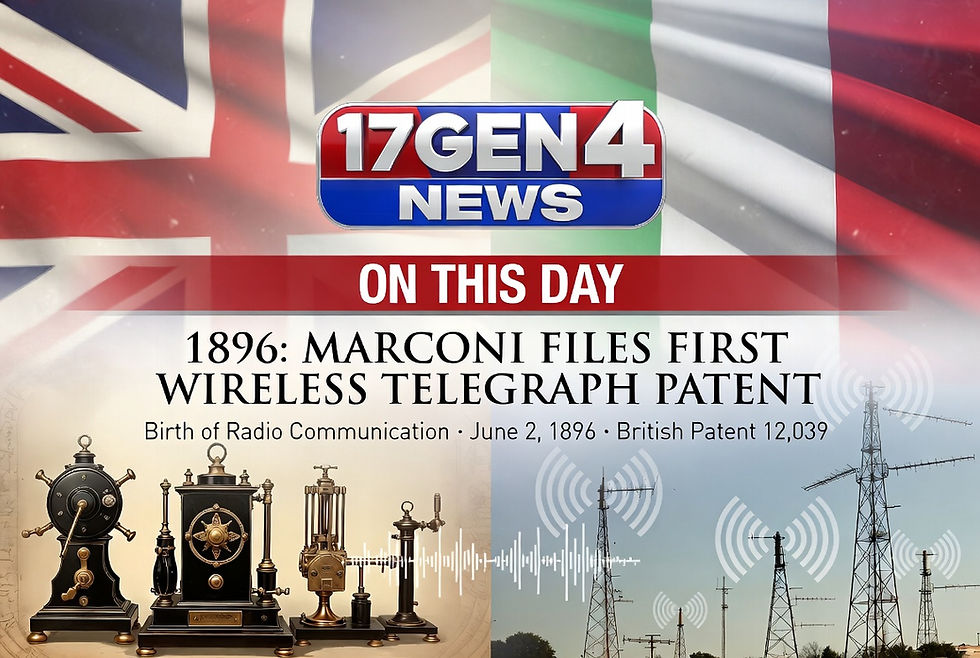
On This Day 1896: Guglielmo Marconi Files First Wireless Telegraph Patent – Birth of Radio Communication | 17GEN4 News
17GEN4 News | June 2, 2026
LONDON — On this day 130 years ago, a 22-year-old Italian inventor named Guglielmo Marconi took a step that would forever change human connectivity. On June 2, 1896, Marconi filed his groundbreaking first patent in the United Kingdom for a system of wireless telegraphy — the foundational technology that enabled radio communication, broadcasting, radar, and the wireless world we live in today.
The Patent That Sparked a Revolution
British Patent No. 12,039, titled "Improvements in Transmitting Electrical Impulses and Signals, and in Apparatus Therefor", described a practical system using Hertzian waves (radio waves) to send Morse code signals without wires. The patent application was formally filed on June 2, 1896, with the complete specification submitted on March 2, 1897, and officially granted on July 2, 1897.
Key elements of Marconi’s early system included:
A spark-gap transmitter (Hertz radiator) powered by an induction coil to generate high-frequency oscillations.
Elevated antennas (initially using metal plates, later vertical wires, kites, or balloons for greater height and range).
A coherer receiver — a glass tube filled with metal filings (often nickel and silver) that “cohered” when hit by radio waves, allowing current to flow and activate a Morse inker or bell.
An automatic “tapper” or trembler to reset the coherer after each signal.
At the time of filing, Marconi had demonstrated transmission over short distances (hundreds of meters). By July 1896, he extended the range to about 400 meters, and within a year, he achieved signals across several kilometers.
Background and Path to Britain
Born in Bologna, Italy, on April 25, 1874, Marconi became fascinated with the experiments of Heinrich Hertz (who proved the existence of radio waves in 1888) and Oliver Lodge. After limited support in Italy, the ambitious young inventor moved to Britain in early 1896 with help from his Irish mother’s family connections. There, he gained crucial backing from Sir William Preece, Chief Engineer of the British Post Office.
Marconi’s decision to patent in Britain was strategic: the UK was a global maritime power with urgent need for ship-to-shore communication, and British patent law offered stronger protection.
Lasting Impact and Legacy
Marconi’s invention rapidly evolved:
1897: First company formed (Wireless Telegraph and Signal Company, later Marconi’s Wireless Telegraph Company).
1901: Historic first transatlantic wireless signal (“S” in Morse code) from Cornwall, England, to Newfoundland.
1909: Shared the Nobel Prize in Physics with Ferdinand Braun.
1912: Marconi equipment aboard the RMS Titanic played a critical role in the disaster’s rescue efforts.
His work directly paved the way for AM/FM radio, television, satellite communication, Wi-Fi, cellular networks, and GPS — technologies that define the 21st century.
Today’s Perspective: On the 130th anniversary of this pivotal filing, Marconi’s vision reminds us how one inventor’s persistence can transform society. From Morse code across oceans to instant global connectivity, the wireless revolution he ignited continues to shape our world.
On This Day 1896: Guglielmo Marconi Files First Wireless Telegraph Patent – Birth of Radio Communication | 17GEN4 News
June 2, 1896 – Italian inventor Guglielmo Marconi files British Patent 12,039 for his wireless telegraph system. The breakthrough that led to radio, transatlantic signals, and the modern wireless era. Full historical details and legacy on 17GEN4 News.
17GEN4 News



Comments