Pentagon Raises Threat of Israeli Spying on U.S. to Highest Level Amid Tensions Over Iran War Strategy
- 17GEN4

- 6 hours ago
- 4 min read
Pentagon Elevates Israeli Spying Threat to 'Critical' Level Over Alleged Surveillance of Trump Officials | 17GEN4 News Exclusive
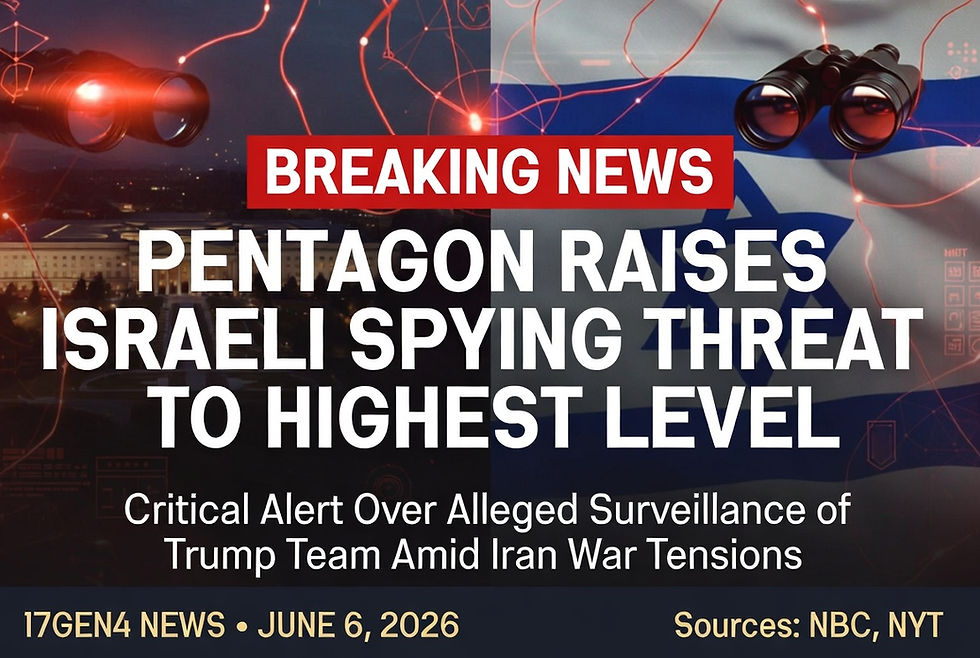
WASHINGTON — In a significant escalation of counterintelligence concerns between two of the closest allies in the Middle East, the Pentagon has raised its assessment of the espionage threat posed by Israel to the highest possible level, according to multiple U.S. officials.
The Defense Intelligence Agency (DIA) issued the updated assessment in recent weeks, elevating Israel’s counterintelligence threat designation to “critical” — the top tier in the Pentagon’s internal ranking system. The move comes amid heightened frictions between the Trump administration and Israeli Prime Minister Benjamin Netanyahu over the direction of the ongoing war with Iran and military operations in Lebanon.
The internal DIA assessment, which includes a seven-page document and accompanying chart, concludes that Israel’s capabilities for both human espionage and technical intelligence collection have reached a “critical level.” It identifies a series of specific incidents that have heightened U.S. concerns, though details remain classified. Officials described Israel’s recent efforts as going “well beyond what is typical and expected espionage” between allies.
Key concerns center on Israel’s alleged surveillance of senior Trump administration officials to glean insights into internal U.S. deliberations on Middle East policy. U.S. intelligence reports specifically highlight efforts to eavesdrop on American negotiators involved in peace talks with Iran, including President Donald Trump’s top envoy Steve Witkoff. Pentagon officials Elbridge A. Colby, the under secretary of defense for policy, and his deputy Michael P. DiMino IV — who oversees Middle East policy — have also been identified as potential targets.
The timing aligns with deepening policy divergences. Following a ceasefire reached in early April 2026 after the U.S.-Israel military campaign against Iran that began on Feb. 28, Trump has prioritized a diplomatic deal to wind down the conflict. Netanyahu, however, has expressed skepticism about Iran’s compliance and pushed for renewed strikes while resisting U.S. pressure to de-escalate against Hezbollah in Lebanon. Tensions boiled over in a recent phone call in which Trump reportedly called Netanyahu “fucking crazy,” according to reports of the exchange.
Counterintelligence incidents involving Israel have reportedly been rising since late 2024, during the final months of the Biden administration’s push to restrain Israeli actions in Gaza, and continued into 2025 under Trump. Examples cited in related intelligence reporting include the 2021 discovery of listening devices planted by Israeli military intelligence at DIA headquarters and a 2025 attempt by Israel’s Shin Bet domestic security agency to install a device in a Secret Service vehicle. More recent cases involved surreptitious software installed on U.S. defense personnel’s phones while in Israel.
U.S. officials emphasized that the elevated threat level does not appear to have disrupted the daily high-level intelligence sharing between the two countries, particularly on Iran-related operations. American personnel already employ standard precautions — such as burner phones and heightened device security — when interacting with Israeli counterparts. However, the new assessment could lead to stricter protocols on information sharing at joint facilities like the U.S.-led Civil-Military Coordination Center in Israel, where U.S.-only and Israeli-only floors already exist for sensitive discussions.
Israel strongly denied the allegations. A spokesperson for the Israeli Embassy in Washington stated: “It is completely false that Israel spies on the U.S. Israel does not gather intelligence on American entities, let alone U.S. government officials. Israel intelligence collection efforts are aimed at its enemies, not its allies. Any claims to the contrary are either misinformed or politically motivated.”
The White House dismissed the reports outright. A senior official told reporters: “This entire story is false and sourced to someone who doesn’t have any knowledge of what’s going on.” The Pentagon declined to comment, and the Office of the Director of National Intelligence did not respond to requests for comment.
Israeli espionage against the U.S. has long been a sensitive issue despite the nations’ tight alliance. The 1980s Jonathan Pollard case — in which the U.S. Navy analyst was convicted of passing classified documents to Israel and served 30 years in prison — remains a point of contention. U.S. intelligence officials have consistently ranked Israel among the most aggressive collectors of American secrets, alongside major adversaries.
Experts note that mutual spying between allies is not uncommon — the U.S. itself was revealed in 2013 Snowden leaks to have monitored leaders like German Chancellor Angela Merkel. However, the current “unhinged” level of Israeli activity, as described by one senior U.S. official, has reportedly surpassed that of any other ally and even some adversaries.
As of Saturday, June 6, 2026, no further official statements or escalations have emerged. The story, first reported by NBC News late Friday and expanded upon by The New York Times on Saturday, underscores the delicate balance of trust in one of America’s most vital security partnerships even as battlefield coordination against Iran continues at unprecedented levels.
17GEN4 News
Pentagon Elevates Israeli Spying Threat to 'Critical' Level Over Alleged Surveillance of Trump Officials | 17GEN4 News Exclusive
Breaking: Pentagon’s DIA raises Israel’s counterintelligence threat to highest “critical” tier amid Iran war tensions. Full details on alleged eavesdropping of Witkoff, Colby & more, official denials, historical context, and what it means for U.S.-Israel alliance. Latest updates as of June 6, 2026.



Comments